

By blending these time-tested ideas with modern materials and design, this model becomes scientifically feasible and ecologically sound.
Global Precedents: Where Similar Ideas Exist
While no identical project currently exists, several global initiatives have explored components of this concept:
| Country | Project | Similar Feature |
|---|---|---|
| Israel | Negev Desert Drip Systems | Water retention, micro-irrigation |
| UAE | Masdar City, Al-Badia Farms | Subterranean cooling, renewable energy |
| Saudi Arabia | Neom “The Line” | Climate-controlled linear habitats |
| Iran | Yazd Wind Towers | Passive underground ventilation |
| China | Inner Mongolia Desert Greening | Sand stabilization and soil retention |
| Egypt | Toshka Project | Desert irrigation through stored Nile water |
The proposed model can be viewed as a unified evolution of these efforts — a holistic architecture that integrates habitation, irrigation, and climate adaptation into a single system.
The Ideal Countries for Implementation
This model is best suited to regions with high aridity, abundant sunlight, and access to renewable or limited water resources:
| Region | Suitability |
|---|---|
| Saudi Arabia, UAE, Oman, Qatar | Ideal climate, strong innovation funding |
| Israel | Advanced irrigation expertise |
| Egypt, Morocco, Tunisia | Vast desert belts near river systems |
| India (Rajasthan, Gujarat) | Semi-arid terrain, strong agricultural base |
| China (Gobi Desert region) | Ongoing large-scale greening programs |
| Australia (Outback) | Potential for eco-tourism and sustainable living |
The Coastal Water Lens: Freshwater Beneath the Sand
The article would be incomplete without exploring your second idea — harvesting naturally filtered freshwater near coastal deserts.
In many islands and beach regions, a phenomenon known as the “Ghyben–Herzberg Lens” occurs. Fresh rainwater, being lighter than seawater, floats above the saline layer underground. As a result, a thin layer of drinkable freshwater accumulates just below the sandy surface.
This means that in many coastal zones, a shallow well (5–15 meters deep) can yield fresh water, naturally purified by sand filtration — without desalination plants.
Such a system could power small-scale farms or communities near coastlines at minimal cost. Combined with solar pumps and underground storage, this creates an affordable, decentralized water network — particularly valuable for small island nations and Gulf coastal regions.
Comparative Analysis: Desert Eco-Farm vs. Coastal Freshwater Wells
| Aspect | Desert Eco-Farming Habitat | Coastal Freshwater Lens System |
|---|---|---|
| Primary Goal | Sustainable agriculture and human settlement | Low-cost freshwater sourcing |
| Infrastructure Cost | Moderate to high | Low |
| Scientific Dependence | Engineering and ecological integration | Hydrological principles |
| Risks | Soil stability, construction complexity | Saline intrusion over time |
| Maintenance | Moderate (irrigation & ventilation) | Minimal (periodic testing) |
| Longevity | Long-term, self-sustaining | Seasonal or rain-dependent |
| Expansion Potential | Agriculture, research, eco-housing | Supplementary water source |
Together, the two systems form a dual sustainability framework — one thriving deep in the desert, the other flourishing along the sea.
Environmental and Social Impact
If realized, this project could transform the socioeconomic fabric of desert regions:
-
Employment & Habitation: Offers self-contained living and working spaces for agricultural communities.
-
Water Conservation: Cuts wastage by over 70%.
-
Renewable Energy Integration: The surface windmills and solar units could power the community off-grid.
-
Desert Reclamation: Prevents soil erosion, increases vegetation cover, and potentially reverses desertification.
-
Cultural Preservation: The architecture borrows from traditional desert wisdom — merging old knowledge with modern sustainability.
In a world facing water wars and climate migration, such models could redefine how and where people live.
The Broader Vision: Turning Sand into Civilization
At its heart, this model is not just about farming or architecture — it’s a philosophy. It reimagines the relationship between human life and the Earth’s most hostile landscapes.
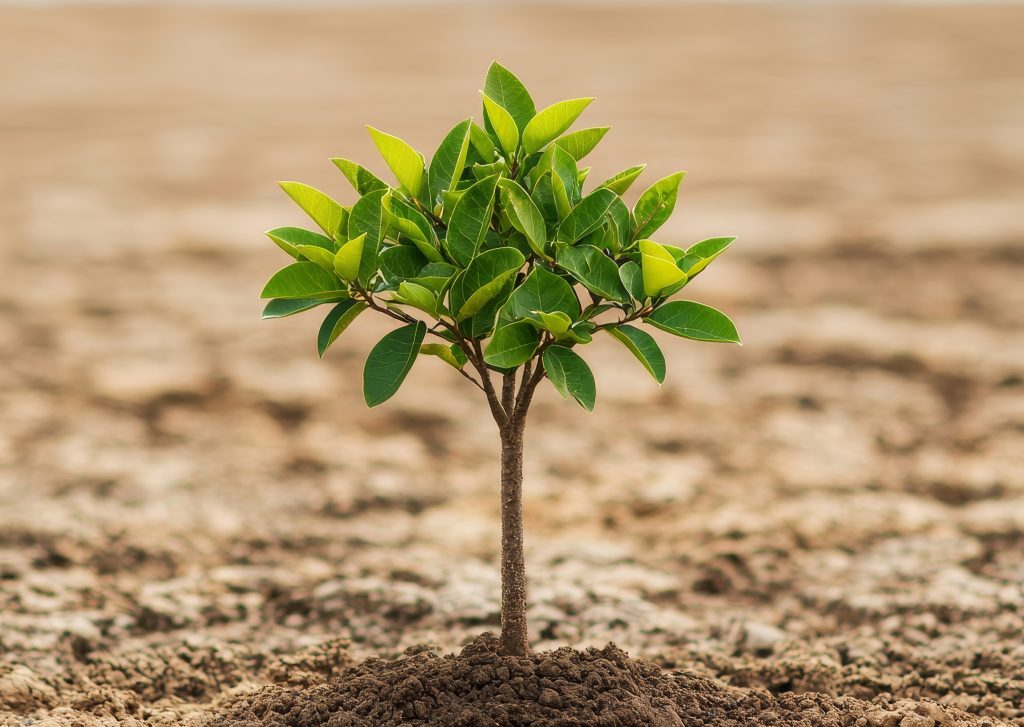
It proposes that deserts need not be “wastelands” waiting to be conquered. They can be re-coded ecosystems, where design, biology, and physics collaborate. Where a seed in the sand can mirror the resilience of the people who plant it.
The underground rooms represent human adaptation. The sealed floor represents scientific precision. The neem and date trees represent life’s persistence. Together, they create a new blueprint for coexistence.
The Future Lies Beneath and Above
The “Integrated Desert Eco-Farm Habitat” and “Coastal Freshwater Lens System” together present a dual vision of humanity’s sustainable future — one under the sand, and one near the sea.
Both utilize natural processes instead of fighting them. They celebrate the intelligence of ecological design — not in grand industrial gestures, but in subtle cooperation with the Earth’s physics.
Perhaps one day, when satellites scan our planet’s deserts, they won’t see endless emptiness. They’ll see green corridors, living domes, and the quiet hum of windmills sending cool air underground — the proof that even the harshest sands can bloom.