

The ‘Celebrity Tag’ on Sacrificial Animals: Marketing Tactics, Social Psychology, and Shariah Perspectives
by Jahangir Alam Shovon
Introduction A peculiar and recent addition to Bangladesh’s pre-Eid-ul-Adha culture is the practice of naming massive sacrificial animals in cattle markets and farms after famous personalities. Livestock that were once recognized simply by their coat color or physical build (e.g., Kala Pahar, Dhola Miah) are now tagged with the names of local celebrities, sports icons, or polarizing global political figures. This ‘naming culture’ is far from a mere whimsical whim of farmers; it represents a complex interplay of modern marketing strategies, social media psychology, and religious solemnity.
1. When Did This Trend Begin?
The practice of naming livestock in this manner is a relatively recent phenomenon in Bangladesh. Its subtle origins trace back to around 2015–2016, coinciding with the rise of commercial dairy farming and well-structured agro-farms. However, it evolved into a widespread cultural phenomenon around 2018–2019, fueled by the rapid expansion of social media platforms like Facebook Live, YouTube vlogging, and TikTok.
Farmers quickly realized that simply showcasing a 1,000 kg bull yielded far less engagement than attaching a sensational name to it. Mainstream media, seeking high-engagement content, began featuring these catchy names in their headlines. As a result, the animal would go viral on millions of smartphones long before even setting foot in the physical market, prompting wealthy buyers to compete for the specific animal as a status symbol.
2. Past vs. Present: Transition from Popular to Polarizing Characters
A profound psychological and qualitative shift can be observed when comparing past naming trends with the current landscape.
-
The Past Trend (Popularity and Admiration): In previous years, farmers typically chose names of individuals who commanded a massive fanbase, deep affection, or intense public fascination. Examples include movie stars like Manna, Shakib Khan, and Dipjol, or sporting icons such as Mashrafe, Messi, Neymar, and Ronaldo. Even blockbusters like Bahubali or Titanic were used to symbolize sheer power and scale. The core strategy here was to capitalize on the positive emotions of fans.
-
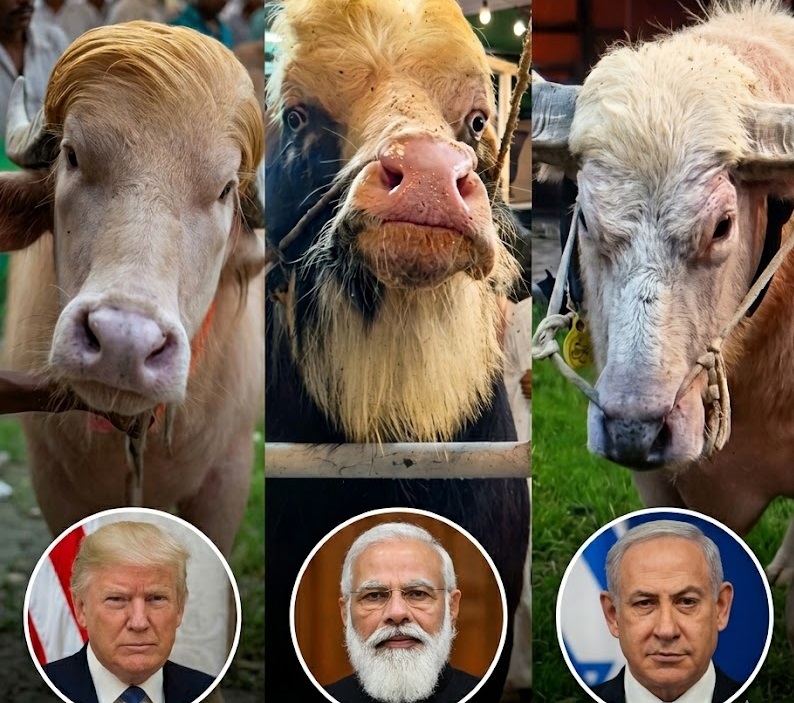
The Current Trend (Negative Marketing and Satire): More recently, the spotlight has shifted toward polarizing global political figures such as Donald Trump, Narendra Modi, and particularly Benjamin Netanyahu. This shift is driven by two distinct psychological factors:
-
Physical and Behavioral Satire: Farmers are no longer just picking random names; they are identifying explicit physical or behavioral resemblances. Examples include an albino buffalo sporting a golden, swept-back tuft reminiscent of Donald Trump’s signature hairstyle, or another with an aggressive, ungrateful temperament dubbed Netanyahu.
-
Negative Marketing: Due to current geopolitical realities and global conflicts, there is an intense wave of public resentment toward certain political leaders. Farmers have cleverly channeled this collective public anger into sharp satire. It subtly caters to a subconscious desire among some individuals to express symbolic defiance or resentment through the act of sacrifice. This marks a transition from capitalizing on public admiration to leveraging public grievance and negative marketing.
-
3. Theological and Social Perspectives from Islamic Scholars
Islamic scholars (Ulema) view this highly sensationalized trend with serious concern, and their viewpoints are largely divided into distinct schools of thought:
-
The Orthodox Stance (Focus on Sanctity and Intent): A large segment of scholars strongly discourages this practice, arguing that Eid-ul-Adha is a deeply sacred act of worship (Ibadah) intended solely to attain Allah’s pleasure. Introducing names of controversial political figures reduces the spiritual gravity of the ritual to mere entertainment. They caution that turning a sacred sacrificial animal into an object of social media trolling and mockery compromises the necessary humility and solemnity required of the occasion.
-
The Pragmatic/Permissible Stance (Focus on Core Shariah Rules): Conversely, But farmers think a strictly literal interpretation of the jurisprudence. They argue that in Islam, animals do not possess official names or identities. Whether a farmer nicknames a bull Netanyahu or Kala Pahar for commercial purposes does not alter the biological status or purity of the animal. According to this view, as long as the buyer’s income is lawful (Halal), their intention (Niyyah) is pure, and the slaughter is dedicated exclusively in the name of Allah, the sacrifice is valid (Sahih). They emphasize the Quranic principle: “It is neither their meat nor their blood that reaches Allah, but it is your piety that reaches Him.”
Conclusion and Analysis
The phenomenon of celebrity branding in Bangladesh’s cattle markets is a direct reflection of a contemporary, social-media-driven “viral culture.” It operates as a highly successful element of the attention economy for farmers while serving as a source of public curiosity and satire for the masses.
However, while these satirical names may dominate digital algorithms, attaching controversial political labels to animals intended for a sacred religious rite clashes with the ideal spirit of the festival. Preserving the sanctity of spiritual traditions from the influence of cheap commercial gimmicks remains a true marker of religious and cultural maturity.


