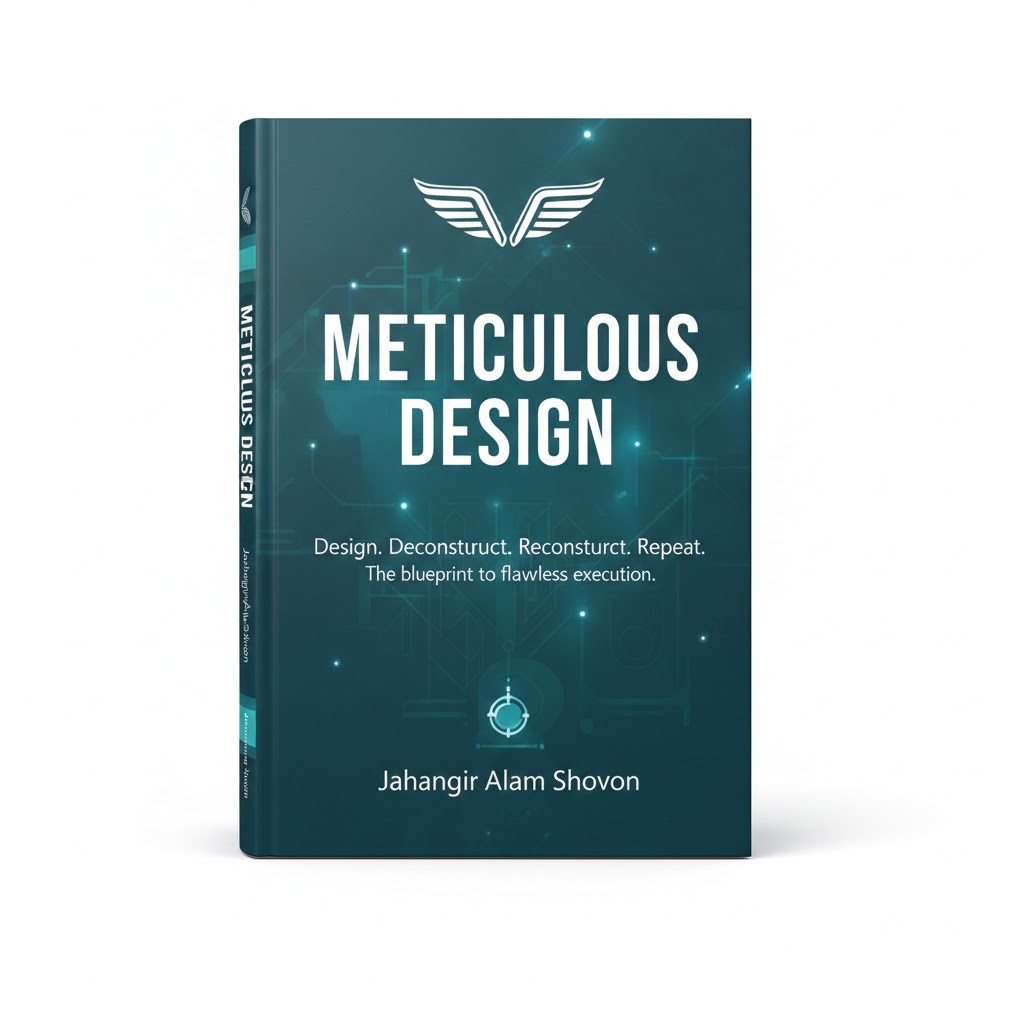

Meticulous Design: An Exploration of Impeccable Planning
A Critical Review of Jahangir Alam Shovon’s Latest Work
There exists an unspoken contract between a reader and a book—I shall invest my time, and you shall impart something of value. Yet, upon immersing myself in Jahangir Alam Shovon’s Meticulous Design, I discovered this contract to be somewhat different. The author does not merely wish to speak; he wishes to demonstrate—how an idea, once embedded in your consciousness, continues to operate within your subconscious. As he states in the introduction, “When something enters our mind, we sometimes begin implementing it in our lives unconsciously, without even realizing it.”
This book belongs to that rare category—one that infiltrates your thought processes, and before you recognize it, becomes an integral part of how you make decisions.
The Journey of a Phrase
“Meticulous Design”—at first hearing, these words might suggest an engineering terminology or a specialized methodology reserved for designers. However, the author carefully positions it as merely “a way of working.” He explains, “Actually, Meticulous Design is simply a method of working.”
To elucidate this method, he employs the Bengali phrase nikhonto noksha (impeccable design). But he does not confine himself to lexical definitions. In the very first chapter, he recounts the story of that irrigation project in Sonagazi, Feni, where Japanese engineers mobilized thirty thousand workers to construct a dam within six hours. Not just the work, but even their attire was modified—lungis replaced with half-pants to ensure no disruption in operations.
This anecdote establishes the tone for the entire work—Meticulous Design is not merely about good planning, but about accounting for every level, every individual, every moment.
Good Versus Excellent: A Distinction That Can Transform Lives
In the second sub-chapter, the author presents a compelling comparison—good design versus excellent design. He writes, “Good design is functional, has limited impact, and fulfills user needs. Excellent design is not only functional but creates long-term impact, enhances user experience, brand image, and leaves a lasting impression.”
To illustrate this distinction, he shares a practical example—the story of two bus services operating on the route to his village home from Dhaka. One company, enjoying a monopoly, neglects service quality; the other follows suit. Consequently, people remain dependent on them despite their frustration. In the author’s words, “Since people have no alternative, they travel with whichever has empty seats available.”
This simple analogy reminds us how often we settle for ‘good’ in life, finding excuses not to pursue the ‘excellent’—and how these very excuses keep us confined.
Seven Operational Principles: A Structured Framework
Perhaps the most potent section of the book is this discussion of seven operational principles. Here, the author transforms Meticulous Design from a philosophical concept into an applicable framework.
1. Commitment to Specific Objectives: Drawing from Peter Drucker’s MBO concept, this principle asserts that if objectives remain ambiguous, the path to implementation also becomes unclear.
2. Structural and Organizational Cohesion: From political party hierarchies to corporate administration—every domain requires a well-integrated structure.
3. Review and Refinement Mechanism: The author makes a crucial observation—organizations that fail to practice this principle become irrelevant over time.
4. Data-Driven and Contextual Methodology: “Policy-making without data is a form of political gambling”—this statement carries particular significance in our national context.
5. Creative Use of Language, Symbols, and Presentation: Using his own book as an example, he explains that purely academic discussion would have made it monotonous, while mere storytelling would have deprived readers of conceptual understanding.
6. Progression and Succession Strategy: Identifying a weakness in Bangladeshi politics, he notes, “The succession crisis is now the greatest vulnerability, creating centralization in the absence or death of a leader.”
7. Ethics and Perspective Balance: This principle emphasizes that every plan must prioritize humanity and the greater good.
The Power of Micro Attention: From Einstein to Newton
In the third sub-chapter, the author invokes stories of Einstein and Newton to illustrate the significance of micro attention. We are familiar with the anecdote about Einstein’s delayed speech, but the author connects it to attention—Einstein didn’t speak earlier because everything was fine; there was no problem to address.
Regarding Newton, he offers a remarkable observation: “One might say Newton was a scientist, so he would observe differently than ordinary people. The interesting thing is, he didn’t become a scientist and then observe differently; rather, he became a scientist by observing differently with deep attention.”
This observation reminds us that we often assume great individuals achieved greatness because they were inherently different. In reality, they became great through their practice of sustained, micro attention.
The Fine Line Between Failure and Success
Perhaps the most poignant chapter in the book recounts the tragic incident in Dinajpur—twenty days after independence, on January 6, 1972, over five hundred freedom fighters perished together in a mine explosion. A single mine slipping from someone’s hand caused this catastrophe.
In the author’s words, “The grief of that mother whose son, after returning victorious from war, turned to ashes—which epic will accommodate that sorrow?”
Immediately following this, he discusses the Bangladesh Bank reserve heist—where hackers had planned so meticulously that but for a spelling error, 850 million dollars would have been siphoned away. A good endeavor fails due to a minor mistake; a malicious one succeeds through meticulous planning—this paradox compels reflection.
The Illusion of Belief and Design
In the eleventh sub-chapter, the author cites the example of ancient Egyptian pharaohs. They believed that preserving their bodies as mummies would ensure resurrection. The author questions, “Despite being false in so many aspects, why does this belief still hold truth?”
Why? Because this belief led them to discover pyramid construction, mummification technology, hieroglyphics—all of which survive to this day. Though they did not return biologically, their names, their creations, their stories—all remain alive. The author observes, “In every sense except biological, they have achieved rebirth.”
Herein lies the greatest lesson of Meticulous Design—an impeccable plan can sustain your existence far longer than your physical presence ever could.
The Language of Color, Form, and Texture
In the fourteenth chapter, the author explores the science of visual pleasure. He elucidates how white space, rhythm, and typography influence our brain function, using simple examples.
He states, “The brain avoids complexity. When typography is clear, white space is adequate, and rhythm is harmonious, the brain experiences relief.”
He then cites the example of political posters in Bangladesh—where leaders employ every imaginable color, resulting in visual chaos. The author humorously remarks, “If I had any such authority, I would first arrange various training programs for politicians, including lessons on aesthetics and color usage.”
Journey or Competition: Two Paths of Life
In the twenty-first chapter, the author presents two fundamental perspectives on life—life as a journey, and life as a competition. Islam supports the former, while modern Western civilization advocates the latter.
However, he does not stop there. He further divides competition into two forms—conventional competition, where you merely excel at what others are doing; and path-breaking innovation, where you create something entirely new.
As examples, he mentions Steve Jobs and Elon Musk. In the Bengali context, he recalls the formation of ‘Prakriti Punja’ after King Shashanka’s death—recognized as the world’s first civil society.
When to Stop: The Balance Between Perfection and Progress
In the final sub-chapter, the author poses a crucial question—when should one stop? Where lies the balance between perfection and progress?
Drawing examples from NASA’s Apollo program, SpaceX’s Falcon 9, the ISS, the James Webb Telescope—he demonstrates how clarity, completeness, harmony, and feasibility must work in concert. He also presents cautionary tales—Leonardo da Vinci’s failed Gran Cavallo project, the tragedy of India’s partition, Hubble Telescope’s initial failure—where pursuing perfection led to significant losses.
Ultimately, he concludes, “Meticulous Design truly achieves perfection when it incorporates the capacity for change and adaptation.”
What Remains Unsaid
In this review, I have necessarily omitted many significant portions of the book—Ibn Khaldun’s life and philosophy, the extraordinary rise of Qutbuddin Aibak, Rockefeller’s dual character of wealth accumulation and philanthropy, Stephen Hawking’s ‘Grand Design’ theory, Elon Musk’s simulation hypothesis, Bruce Lipton’s four misconceptions, and even the provocative question—”Are humans children of Earth or cosmic visitors?”
The author has incorporated nearly two hundred examples drawn from personal experience, history, science, and everyday life. Sometimes he narrates stories of Operation Jackpot during the Liberation War, sometimes he discusses the Leaning Tower of Pisa, sometimes he shares his son’s science fair project.
This book is essentially a map—as the author himself describes, “This can be called a map of Meticulous Design.” Following this map may not lead you to a specific destination, but you will certainly learn the methodology of navigation. And perhaps that is the author’s primary objective.
As he stated at the beginning, “If someone thoroughly understands the various aspects of Meticulous Design, it will serve them somewhere or everywhere in life—sometimes consciously, sometimes unconsciously.”
Having completed the book, I sense that this ‘somewhere’ has already begun working within me. And perhaps it will within you as well.
All Books of Jahangir Alam Shovon:
https://www.rokomari.com/book/author/49409/jahangir-alam-shovon