

A Third State: A Realistic Solution for Resolving the Israel–Palestine Conflict
-Jahangir Alam Shovon
Like many across the globe, the issue of Palestine has captured my attention since childhood. Despite the two World Wars that shaped the 20th century, this conflict has persisted for more than a hundred years, making it one of the longest and most unresolved crises in modern history—one that has, at times, resulted in profound humanitarian catastrophes.
In my professional life, I have engaged with various institutions and even contributed proposals that were considered at national and organizational levels. These experiences have enhanced my confidence in developing ideas to address complex challenges. During my travels across different countries in recent years, I developed a habit: I would observe local problems, formulate possible solutions, and share those suggestions with the respective authorities via written correspondence. This not only brought me satisfaction, but deepened my interest in global affairs.
This background—my commitment to creative problem-solving, my engagement with governmental proposals, and my exposure to international challenges—led me to rethink the Israel–Palestine conflict from a unique angle.
Two seemingly simple stories involving cats unexpectedly shaped my outlook on this issue. In one case, I saw two cats in a fierce standoff. After their initial fight subsided, they continued growling at one another. I attempted to break the tension by spraying water, but this escalated the confrontation—they attacked each other so violently that they fell off a rooftop. Their fate was unknown to me.
In contrast, I later witnessed another conflict where a third cat intervened—positioning itself between the fighting pair, making subtle movements to calm both. To my amazement, it succeeded in diffusing the tension.
These encounters made me ponder the human parallels. The presence of a calm, neutral third party—especially in international affairs—can often de-escalate conflict and facilitate compromise. Given the growing intensity of the Israel–Palestine crisis over the past two years, I found this analogy increasingly relevant.
As I revisited the historical roots of the conflict, I found that while many solutions had been proposed, none had addressed what I am about to present. I saw parallels with the partition of India and Pakistan, where, despite the historical and geopolitical logic behind a two-state solution, a third state—Bangladesh—emerged 24 years later out of necessity. This suggests that the initial framework was not fully adequate.
Similarly, the two-state solution proposed by global leaders for Israel and Palestine in 1947 has repeatedly failed over the past 78 years, with each failure marked by loss of life, displacement, and deepened animosity. The international community has largely urged Israel to show restraint and Palestine to accept Israel’s terms, but few have seriously explored alternative models.
Thus, as a global citizen—armed only with the tools of critical thinking, creative imagination, and a strong belief in peace—I humbly offer a new proposal. This idea is rooted not in ideology or identity politics, but in diplomacy, practicality, and the hope of lasting peace.
Historical Backdrop and the Need for Rethinking
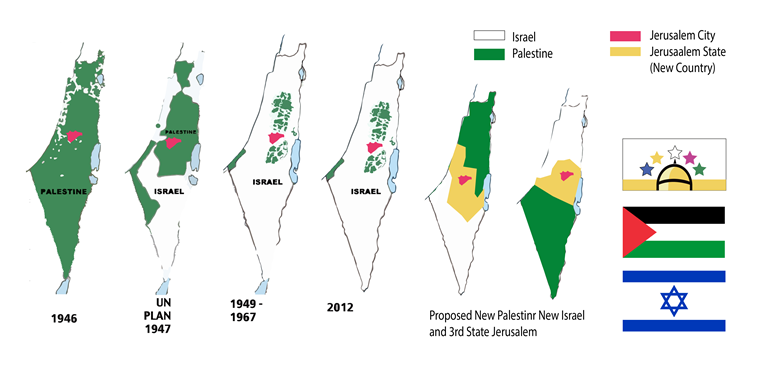
Under the British Mandate in 1946, the region known as Palestine comprised approximately 27,000 square kilometers. Today, Palestinians primarily govern the West Bank and Gaza Strip, covering around 6,020 square kilometers—less than 22% of the territory once under Palestinian control. This drastic territorial shift reflects profound geopolitical transformations over the decades.
In 1947, the United Nations proposed a partition plan, dividing the land between a Jewish and an Arab state. The proposal allocated nearly 56% of the land—about 15,128 square kilometers—to the Jewish population, which at the time made up only 27% of the inhabitants. Conversely, approximately 43% of the land (around 11,672 square kilometers) was allocated to the Arab Palestinian population, which comprised roughly 62% of residents.
Following the events of 1948, Israel expanded its territorial control to approximately 78% of the total area—nearly 20,864 square kilometers. In effect, it absorbed an additional 22% beyond the original allocation, significantly altering the landscape and further diminishing the Palestinian share.
Sites of Cultural and Spiritual Significance
A central complexity in this region lies in its profound cultural and religious value to multiple communities:
- Al-Aqsa Mosque, revered in Islam, is located in the southeastern corner of Jerusalem’s Old City.
- The Church of the Holy Sepulcher, a sacred site in Christianity, lies in the northwest of the same city.
- The Western Wall, a deeply significant location in Jewish tradition, is situated along the Old City’s western edge.
- The Dome of the Rock, iconic to multiple traditions, lies at the heart of Jerusalem.
This shared reverence underscores the deeply layered emotional, historical, and communal significance of the territory—complicating simple territorial divisions.
Past Proposals and Missed Opportunities
Before the establishment of modern Israel, several alternative proposals were discussed during the 1940s in an attempt to resolve the issue through relocation or cohabitation. These included:
- The creation of a unified, national state—a concept that was ultimately rejected by both communities at the time.
- The resettlement of Jewish populations on Madagascar—deemed logistically and politically impractical.
- A semi-autonomous homeland within a province of the former Soviet Union—this too failed to gain consensus.
- Establishing a Jewish state in uninhabited parts of Africa—again, the idea lacked both support and practicality.
- Distributed resettlement of Jewish communities across various countries—a plan largely resisted by host nations at the time.
Each of these ideas faltered due to geopolitical hesitations, identity-based claims, or demographic complexities. As time progressed, violence, population displacement, and hardened political lines rendered most previous models obsolete or unrealistic.
The Three-State Vision: A Framework for Sustainable Coexistence
Given the recurring failure of conventional approaches, it is time to consider an alternative: a three-state model. This vision divides the land historically known as Palestine—originally about 27,000 square kilometers—into three zones:
- A sovereign Palestinian state under Palestinian governance
- A sovereign Israeli state under Israeli governance
- A newly constituted neutral state, tentatively named Jerusalem, governed through international consensus and mutual cooperation
This third state would serve not only as a geographical buffer but also as a social and political bridge—facilitating peaceful cohabitation among diverse populations. It would not fall under the sovereignty of either Israel or Palestine but would evolve into an independent entity through a phased process.
Foundational Principles for the New State (Tentatively: “Jerusalem”)
- The population would include Israelis, Palestinians, Arab Christians, and, as agreed upon, a limited number of individuals from other ethnic or national identities.
- The territory would cover approximately 6,800 km²—comparable to the greater Jerusalem District—and would ensure proportional representation, access to the sea, and economic sustainability.
- Residents from both Israel and Palestine would be surveyed and invited to voluntarily join the new state. If fewer than 10% from either population expresses interest, the territory size may remain minimal. If more, it can be adjusted accordingly.
- The capital would be Jerusalem City, and the new state would adopt its own flag, administrative institutions, and public services.
- A peacekeeping force, initially under international oversight, would maintain order. Over time, domestic security personnel would be trained and empowered to take over.
- The state would operate independently of both Israeli and Palestinian jurisdictions. Citizens of neighboring countries would require registration to enter, and other international travelers would require a visa.
- Governance would remain under an international council for a transitional period. Representation would include stakeholders from Israel, Palestine, and designated neutral parties.
- Sacred and disputed areas—including Al-Aqsa Mosque and the Church of the Holy Sepulchre—would fall under the direct administration of a central council to ensure impartiality.
- Up to 1 million individuals could be granted residency in the first phase, subject to international vetting and phased settlement. Funding mechanisms would be established for infrastructure and services through a combination of UN resources, development aid, and regulated private investment.
- The new state would act as a neutral zone between Israel and Palestine, serving as a buffer and eliminating the need for shared or contested borders.
- Demographic balance would be maintained. No single community—whether Israeli, Palestinian, or foreign—would hold an absolute majority.
- Freedom of movement would be granted to peaceful residents of both Israel and Palestine, except to those restricted by the council or international authorities.
- Military personnel would require advance approval to enter and would be prohibited from carrying arms or entering in groups larger than ten.
- The state would hold full sovereignty, including issuing passports, national IDs, maintaining embassies, and representing itself at international forums.
- Although Israelis and Palestinians would have visa-free access, their number would be capped daily to ensure stability.
- The airspace would be designated a “no-fly zone,” except for approved civilian flights.
- Only individuals committed to peace and coexistence would be eligible for permanent residence.
- Legal safeguards and minority protections would be enshrined in the founding charter.
- A phased migration and repatriation plan could be considered, allowing displaced Israelis and Palestinians to resettle voluntarily in host countries such as the U.S., Europe, or neighboring Arab states, subject to international agreements.
- The governing council—tentatively called the PeaceLand Council—would include representatives from Israel, Palestine, regional neighbors, the United Nations, and select international observers.
Feasibility: Can Such a Small State Function Effectively?
Skepticism is natural. However, history provides ample precedent. Among the world’s smallest countries by area, many are sovereign, recognized, and fully functional states. For example:
- Monaco spans just 2 km²
- Nauru covers 21 km²
- Tuvalu: 26 km²
- Maldives: 300 km²
- Palau, the largest of the ten smallest nations, has an area of only 498 km²
Despite their size, these nations exercise full sovereignty. Some lack military forces, relying instead on defense agreements with allies. The smallest among them, the Vatican, is often excluded due to its unique religious role, but remains globally recognized.
Hence, a new state covering 6,800 km²—ten times the size of many existing microstates—is both realistic and administratively viable, especially if it serves a broader geopolitical purpose. If structured as a corridor or buffer between Israel and Palestine, its length can accommodate strategic separation without excessive expansion. Additional territory can be allocated to ensure access to sea routes and natural resources.
Proposed Population Distributions: Historical & Strategic Models
Although 1 million is shown here, since the area of the Jerusalem district is more or less 20% of the total land area and some additional areas including the sea border, it is logical that the new proposed country of Jerusalem will have a population of 2 million or 2 million people. However, for the convenience of discussion, 1 million settlements have been discussed. Because even if there is a country with a population of 1 million, it will be larger than at least 40 countries in the world.
To maintain neutrality and shared governance, the new state must ensure no single community holds a majority. Below are two population distribution models based on different approaches:
A) Based on 1947 Demographic Ratios
| Model | Palestinians | Israelis | Arab Christians | Arab Muslims (non-Palestinian) | Other Jews | Others |
| 01 | 55% | 30% | 5% | 5% | 5% | — |
| 02 | 50% | 30% | 10% | 10% | — | — |
| 03 | 45% | 25% | 10% | 10% | — | 10% |
| 04 | 40% | 20% | 10% | 15% | — | 15% |
This method is intended to reflect both historical claims and present-day realities, while keeping the spirit of shared ownership alive.
B) To Prevent Majoritarian Dominance
| Model | Palestinians | Israelis | Arab Christians | Other Arab Muslims | Other Jews | Global Citizens |
| 01 | 20% | 20% | 10% | 20% | 20% | 10% |
| 02 | 25% | 25% | 10% | 10% | 10% | 20% |
| 03 | 30% | 30% | 10% | 10% | 10% | 10% |
The aim is to foster a population where no group alone can dominate, but multiple communities can form temporary or rotating majorities through consensus, preserving social equilibrium.
Governance Structure
A 25-member Council would oversee the new state’s transition and administration. Representation may include:
- 1 member each from: Palestine, Israel, Arab Christians, United Nations, and the Arab League
- 20 members chosen based on demographic representation or direct election
- The structure may evolve from initial appointment to full democratic election within 5–10 years
Comparative Table: Small Countries and Proposed State
| Type | Country/Region | Population | Area (km²) | Density (per km²) | Remarks |
| Proposed State | Jerusalem | 1 million | 6,800 | 147 | Balanced, neutral proposal |
| 2nd Smallest by Area | Monaco | 38,000 | 2 | 19,000 | 178th in population |
| 3rd Smallest by Area | Gibraltar | 30,000 | 6.8 | 4,450 | UK overseas territory |
| Densely Populated Island | Singapore | 5.9 million | 725 | 8,000 | Successful urban state |
| High-Density Territory | Macau | 690,000 | 30 | 21,800 | Chinese SAR |
| Large Country | China | 1.4 billion | 9.38M | 151 | Global power |
| Small Dense Island | Maldives | 521,000 | 300 | 1,737 | Independent island state |
| ~1M Population Example | Djibouti | 884,000 | 23,200 | 38 | Example of low density |
| Smaller Than Proposed | St. Kitts & Nevis | 47,745 | 261 | 183 | Caribbean island nation |
Concluding Reflection
The envisioned state of Jerusalem is not simply about redrawing borders. It is about reimagining cohabitation, resetting cycles of hostility, and crafting a sustainable future rooted in mutual dignity.
This proposal draws its strength from:
- Historical patterns of unresolved partitions
- The failure of binary frameworks
- Real-world examples of small but sovereign nations
- The universal yearning for peace
If this proposal resonates, it is not because of its size—but because of its spirit: to transform sacred contention into shared commitment.
Disclaimer: The flags and maps shown in the image are not accurate and definitive. They are the subject of extensive discussion and fieldwork. These two images are presented to illustrate the initial idea or proposal.
Jahangir Alam Shovon: A Bangladeshi Writer and Social Activist
Pic: A New Collage of Maps and Flags By writer



The envisioned state of Jerusalem is not simply about redrawing borders. It is about reimagining cohabitation, resetting cycles of hostility, and crafting a sustainable future rooted in mutual dignity.
This proposal draws its strength from:
Historical patterns of unresolved partitions
The failure of binary frameworks
Real-world examples of small but sovereign nations
The universal yearning for peace
If this proposal resonates, it is not because of its size—but because of its spirit: to transform sacred contention into shared commitment.