

Seeking New Perspectives and Approaches to Resolve the Israel-Palestinian Crisis
Casualties
From the 1948 Nakba (Palestinian Catastrophe) to April 2024, over 134,000 Palestinians have been killed in Israeli aggression. Between 2000 and April 2024, approximately 46,000 Palestinians were killed, including over 35,000 in Israeli attacks on Gaza since October 2023. While exact injury figures are hard to determine, hundreds of thousands of Palestinians have been wounded.
Despite scarce precise statistics, Israeli blockades and conflicts have exacerbated food shortages and malnutrition in Gaza and the West Bank, causing numerous deaths. Over 14,873 children have been killed in the Gaza war alone.
Displacement
During the 1948 Nakba, ~800,000 Palestinians were displaced from their homeland. Currently, ~6.56 million (65.6 lakh) live as refugees in Arab countries, with ~800,000 in other nations.
In 1946, Palestine’s total population was ~1.9 million (19 lakh). Accounting for high birth rates, natural growth would place the current population at ~14.63 million.
Land Distribution: Israel and Palestine
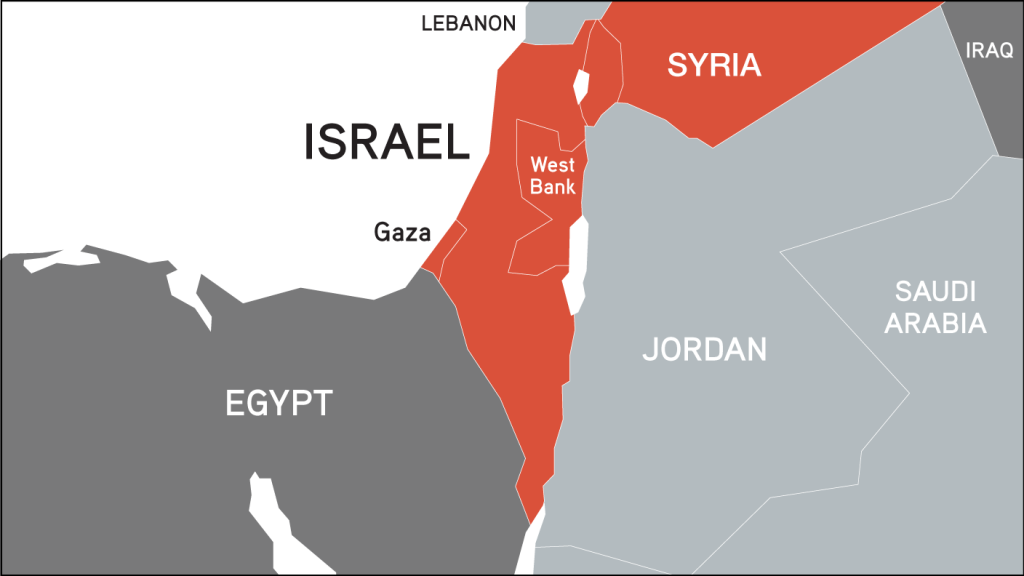
In 1946, under the British Mandate, Palestine’s total area was ~27,000 km². Today, Palestinians control the West Bank and Gaza Strip (~6,020 km²), just ~22% of historic Palestine. This marks a significant reduction from 1946, reflecting historical and political shifts.
Historical Timeline:
-
Pre-1946 (Ottoman Era): Total area = 27,000 km².
-
1947 UN Partition Plan:
-
Jewish State: 56% (~15,128 km²), despite Jews being 27% of the population.
-
Arab State: 43% (~11,672 km²), with Arabs constituting 62%.
-
-
Post-1948 War: Israel expanded control to ~78% (~20,864 km²), annexing ~35% of land designated for Arabs. Compared to the UN plan, Israel seized ~22% extra land.
Jerusalem and Al-Aqsa Mosque Compound
Al-Aqsa Mosque is located in the southeastern Old City of Jerusalem. The entire compound (Haram al-Sharif) covers 144,000 m² (14.4 hectares). Jerusalem’s Old City spans 0.9 km² (90 hectares), housing holy sites of three faiths:
-
Islam: Al-Aqsa Mosque and Dome of the Rock.
-
Christianity: Church of the Holy Sepulchre.
-
Judaism: Western Wall (Kotel).
Al-Aqsa occupies ~16% of the Old City.
Jerusalem District covers ~6,800 km² (25.18% of historic Palestine). Al-Aqsa constitutes ~0.2% of this district. Israel fully controls Jerusalem today, though Palestinians claim East Jerusalem as their capital. Israel annexed East Jerusalem after the 1967 Six-Day War, declaring it its capital—a move internationally contested.
East/West Jerusalem:
-
East Jerusalem (pre-1967): 670 km² (2.48% of Palestine).
-
Jerusalem City (total): 710 km² (2.63% of Palestine).
-
West Jerusalem: 40 km².
Holy Sites:
All major religious sites (Al-Aqsa, Dome of the Rock, Church of the Holy Sepulchre, Western Wall) are in East Jerusalem.
Failed Solutions
-
Binational State: Resulted in a contested Israel; Palestine unrealized.
-
Resettlement in Madagascar: Israel rejected.
-
Autonomous Region in Russia: Israel rejected.
-
State in African Territory: Israel rejected.
-
Global Resettlement: Israel rejected; no host nations accepted.
-
Two-State Solution: Established unjustly by the West/Israel, enabling Palestinian displacement.
Proposed Alternative Solutions
(Novel or previously unaddressed approaches)
A. Third-Party Concept (Three-State Proposal)
-
Structure:
-
State 1: Palestine.
-
State 2: Israel.
-
State 3: Neutral “Jerusalem” (sovereign state covering disputed areas/Jerusalem District).
-
-
Jerusalem State Features:
-
Administered by a UN-backed council.
-
Open to Palestinians/Israelis without visas (registration required). Others need visas.
-
Demilitarized: No armed forces/personnel without permission.
-
Population quotas: Ensures no majority group (see options below).
-
UN peacekeepers handle security; no-fly zone enforced.
-
Sea access guaranteed.
-
Direct UN membership; own flag, currency, passport.
-
Population Quotas for Jerusalem State:
-
Option 1: Palestinians 55%, Israelis 30%, Arab Christians 5%, Other Arabs 5%, Other Jews 5%.
-
Option 2: Palestinians 50%, Israelis 30%, Arab Christians 10%, Other Arabs 10%.
-
Option 3: Palestinians 45%, Israelis 25%, Arab Christians 10%, Neighboring Arabs 10%, Global citizens 10%.
-
Option 4: Palestinians 40%, Israelis 20%, Arab Christians 10%, Neighbors 15%, Global citizens 15%.
Governance:
-
25-member council: Palestine, Israel, Arab Christians, UN, and Arab League reps + 20 members elected by population.
“UN Peace Land” Attributes:
-
UN-administered council.
-
Population controlled by quotas.
-
No ethnic majority.
-
No unauthorized military entry/weapons.
-
No use of land/airspace for war.
-
Citizenship revoked for rule violations.
-
Independent UN member state.
-
Demilitarized 10-km border zone.
-
Police but no army; distinct international identity.
-
Representation in Arab League/regional bodies.
-
Guaranteed sea access.
B. Four-State Proposal
-
Jerusalem City State: 710 km² (sovereign).
-
Gulfland State: 6,000 km² (neutral, separating Israel/Palestine).
-
Population: Israelis + Palestinians (30%), Other Arabs (30%), Global citizens (30%), UN-selected (10%).
-
Shortfalls filled by: Arab Muslims (if Palestinians insufficient), global Jews (if Israelis insufficient), global Christians (if Arab Christians insufficient).
C. Five-State Proposal
-
Palestine: 43% land (UN 1947).
-
Israel: 33% land (per 1946 demographics).
-
Jerusalem City: 4% (~1,000 km²).
-
Gulfland: 10% (~2,700 km²).
-
Friendland: 10% (~2,700 km²; for Arab/Israeli cohabitation).
-
All initially under UN “Peace Land” framework.
Advantages of Microstates
-
Sea access and territorial buffers prevent direct conflict.
-
Joint coalitions (5-state bloc + neighbors like Egypt/Jordan).
-
Tourism/global investment hubs.
-
Safe haven for peace advocates.
-
Democratic self-governance.
-
Pathway to lasting peace.
-
Global stake holding ensures multilateralism.
-
Dissenting voices (e.g., anti-Hamas Palestinians, anti-Israeli government Jews) gain platforms.
Feasibility of Small States
-
Examples: Monaco (2 km²), Nauru (21 km²), Tuvalu (26 km²), Maldives (300 km²), Palau (459 km²).
-
Jerusalem State (710 km²): Comparable to Singapore (721 km²); viable as a demilitarized “Peace Land” under UN. Requires port access.
-
Governance: 21-member council (50% local elected, 20% Israel/Palestine, 20% neighbors/Arab League, 10% UN).
-
Since Student life, it has been my personal habit to contemplate national problems and devise solutions. Around 90% of the solutions I proposed for Bangladesh’s national issues proved correct. Later, others suggested some solutions I saw in newspaper columns. Some were implemented following advice, and I observed their execution. For five years, I worked with a private organization on policy-level engagements with the government. There, I saw the acceptability of my proposals range from 10% to 70%, with up to 30% being adopted in various policies. This experience bolstered both my expertise and self-confidence. Between 2024-25, I sent nearly 600 pages of proposals and countless letters to various departments addressing national issues.
I have pondered international issues since childhood but now study them rigorously to develop solutions.
– Jahangir Alam Shovon